Mortgage Stress Test Canada 2026: How It Works, Rules, and How to Qualify
-1.jpeg)
March 18, 2026
What Is the Mortgage Stress Test in Canada (2026) and Why Does It Matter?
The mortgage stress test in Canada is a regulatory requirement that ensures borrowers can afford their mortgage even if interest rates increase.
In 2026, lenders must assess your ability to repay using a higher qualifying rate, not just your actual mortgage rate. This rule directly impacts how much you can borrow, who qualifies, and how homebuyers plan their finances.
For anyone buying a home, refinancing, or switching lenders in Canada, understanding the stress test is essential to avoid surprises during the approval process.
What Is the Canadian Mortgage Stress Test?
The Canadian mortgage stress test is a financial qualification rule enforced by the Office of the Superintendent of Financial Institutions (OSFI) and applied by federally regulated lenders such as banks.
It is designed to evaluate whether a borrower can still afford their mortgage if interest rates rise significantly over time.
2026 Stress Test Rule
.jpeg)
As of 2026, borrowers must qualify at the higher of:
- 5.25% (benchmark rate)
- Their mortgage contract rate + 2%
This means even if your lender offers you a lower interest rate, your approval is based on a higher, more conservative rate.
Who Does the Stress Test Apply To?
The stress test applies to most borrowers working with traditional lenders in Canada.
You must pass the stress test if you:
- Apply for a new mortgage with a bank or federally regulated lender.
- Refinance your existing mortgage to access equity or stretch your amortization.
- Have a down payment of 20% or more (uninsured mortgage) and are applying for a new loan.
When it does NOT apply (The Straight Switch Exemption): As of late 2024, OSFI introduced the straight switch exemption. If your mortgage is up for renewal and you move to a new federally regulated lender without increasing your loan amount or your amortization period, you are completely exempt from the stress test. You also do not need to pass it if you are simply renewing with your current lender. Knowing this prevents you from getting trapped with your current lender's uncompetitive renewal rates.
2. The Nuance of GDS/TDS Limits
Gross Debt Service (GDS) and Total Debt Service (TDS) ratios are the primary metrics lenders use.
Gross Debt Service (GDS) GDS measures the percentage of your income spent on housing costs.
- Formula: (Housing Costs ÷ Gross Income) × 100
- Standard Limit: ≤ 39%
Total Debt Service (TDS) TDS includes all debts, not just housing.
- Formula: (Housing Costs + All Debts ÷ Gross Income) × 100
- Standard Limit: ≤ 44%
The Real-World Nuance: While 39% and 44% are strict, absolute hard stops for CMHC-insured mortgages (where you put less than 20% down), uninsured mortgages (20% or more down) operate differently. If you have an exceptional credit score, significant liquid assets, or a high net worth, alternative and even some prime lenders can stretch these ratios. They are not always absolute brick walls if you bring strong financial backing to the deal.
3. The Hard Truth About Private Lenders
While federally regulated lenders must follow stress test rules, there are alternative options. However, you need to understand the brutal financial reality of these paths.
1. Credit unions
- May have more flexible qualification criteria.
- Provincially regulated credit unions are not federally mandated to apply the OSFI stress test, though many still use an internal version to gauge risk.
2. Private lenders (The Hard Truth)
- Focus almost entirely on the property's equity rather than your income.
- The Cost: Do not view private lending as a long-term solution. It is a costly, temporary band-aid. Private lenders charge exorbitant setup fees, often 1% to 3% of the total loan amount, deducted right off the top.
- The Rates: You will pay significantly higher interest rates that are almost always strictly interest-only, meaning your payments do not reduce the principal balance. Only use a private lender if you have a concrete, realistic exit strategy to transition back to a traditional lender within 12 to 24 months.
How Do Lenders Calculate the Mortgage Stress Test in Canada?
.jpeg)
Lenders calculate the mortgage stress test by assessing your financial profile using a higher qualifying interest rate, not your actual mortgage rate.
This ensures your mortgage remains affordable under stricter financial conditions.
The process is standardized across most federally regulated lenders, making it a core part of mortgage approval in Canada.
What Factors Do Lenders Evaluate During the Stress Test?
Lenders use a structured evaluation model based on income, debt, and housing costs.
1. Income Assessment
Your gross annual income is the starting point. This may include:
- Salary or hourly wages
- Bonuses (if consistent)
- Self-employment income (with documentation)
- Rental or investment income (in some cases)
Stable and verifiable income increases your chances of qualifying.
2. Debt Obligations
Lenders review all existing debts to calculate your financial burden.
Common debts included:
- Credit card balances
- Car loans or leases
- Student loans
- Personal loans or lines of credit
Higher debt reduces your borrowing capacity under the stress test.
3. Housing Costs
Your projected housing expenses are added into the calculation, including:
- Mortgage payments (based on the stress rate)
- Property taxes
- Heating costs
- Condo fees (if applicable, usually 50% counted)
These costs are critical for determining affordability ratios.
What Are GDS and TDS Ratios?
.jpeg)
Gross Debt Service (GDS) and Total Debt Service (TDS) ratios are the primary metrics lenders use.
Gross Debt Service (GDS)
GDS measures the percentage of your income spent on housing costs.
Formula: (Housing Costs ÷ Gross Income) × 100
Limit: ≤ 39%
Total Debt Service (TDS)
TDS includes all debts, not just housing.
Formula: (Housing Costs + All Debts ÷ Gross Income) × 100
Limit: ≤ 44%
Example: Full Stress Test Breakdown
Scenario:
- Annual income: $100,000
- Monthly gross income: ~$8,333
- Mortgage payment (stress rate): $2,800
- Property tax + heating: $400
- Other debts: $600
Step 1: Calculate GDS
($2,800 + $400) ÷ $8,333 = 38.4% (within limit)
Step 2: Calculate TDS
($2,800 + $400 + $600) ÷ $8,333 = 45.6% (above limit)
Result: Even though housing costs are acceptable, total debt exceeds limits—meaning the borrower may not qualify.
How Interest Rates Influence Your Qualification
The stress test becomes stricter when:
- Interest rates rise
- The contract rate increases
- Inflation impacts lending conditions
Key insight:
Even a 0.5%–1% increase in rates can significantly reduce your borrowing power.
Fixed vs Variable Mortgages Under the Stress Test
The stress test applies to both fixed and variable-rate mortgages, but the impact may differ.
Fixed-rate mortgages
- More predictable payments
- Easier to plan long-term affordability
Variable-rate mortgages
- Payments may fluctuate
- Still stress-tested at higher qualifying rates
Lenders do not relax stress test rules based on mortgage type.
Advanced Scenario: High-Income vs High-Debt Borrowers
High-income borrower
- Easier to pass stress test
- More flexibility in loan size
High-debt borrower
- Limited approval capacity
- May need to reduce liabilities
Conclusion: Income alone is not enough, debt management is equally critical.
How Can You Pass the Mortgage Stress Test in Canada?
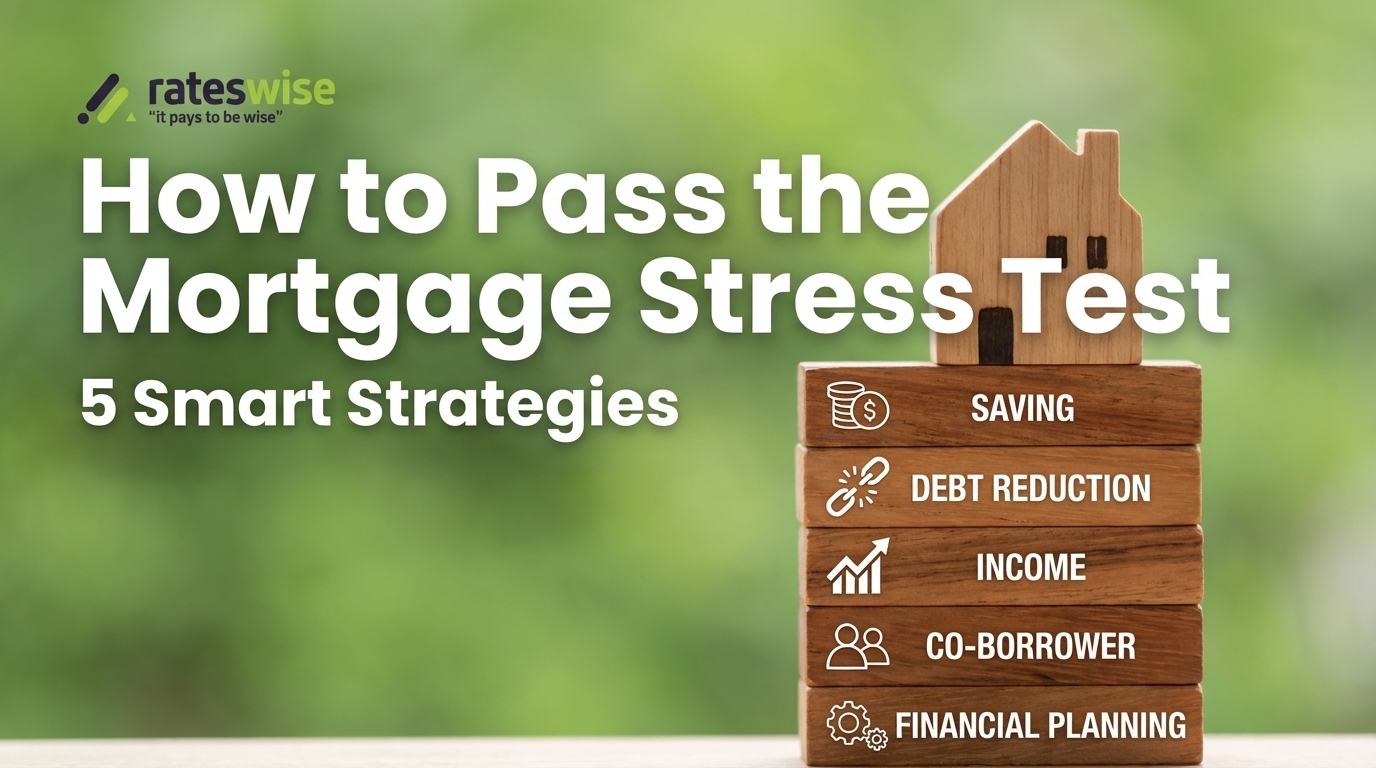
You can pass the mortgage stress test by improving your financial profile, reducing debt, and optimizing how lenders evaluate your application. In 2026, qualification is stricter, but there are practical strategies that can significantly improve approval chances.
1. Increase Your Down Payment
A larger down payment reduces the total mortgage amount, making it easier to qualify under stress test conditions.
Why it works:
- Lower loan amount = lower monthly payments
- Improved GDS and TDS ratios
- Reduced lender risk
Example:
Increasing your down payment from 10% to 20% can meaningfully improve affordability and approval outcomes.
2. Reduce Existing Debt Before Applying
Debt is one of the biggest barriers to passing the stress test.
Focus on paying down:
- Credit cards (high-interest impact)
- Personal loans
- Car financing
Why it matters:
Lower debt improves your TDS ratio, which is often the limiting factor in mortgage approval.
3. Increase Your Verifiable Income
Lenders prioritize stable and documented income.
Ways to strengthen your income profile:
- Include dual household income
- Provide consistent self-employment records (2+ years)
- Add rental income (if applicable and accepted by lender)
Important:
Only income that can be verified and sustained is considered.
4. Add a Co-Borrower
Adding a co-borrower (such as a spouse or family member) can significantly improve your application.
Benefits:
- Combined income increases qualification limit
- Better debt-to-income ratios
- Shared financial responsibility
This is a common strategy for first-time buyers in Canada.
5. Extend Your Amortization Period
A longer amortization period reduces monthly mortgage payments.
Example:
- 25-year amortization → higher monthly payments
- 30-year amortization → lower monthly payments
Result:
Lower payments improve GDS and TDS ratios, making it easier to pass the stress test.
6. Work With a Mortgage Broker
A licensed Canadian mortgage broker can help you:
- Compare multiple lenders
- Identify flexible underwriting options
- Structure your application for better approval
Why this matters:
Not all lenders assess applications in exactly the same way. Brokers can match you with lenders suited to your financial profile.
What Lender Options Exist Beyond Traditional Banks?
While federally regulated lenders must follow stress test rules, there are alternative options.
1. Credit unions
- May have more flexible qualification criteria
- Not always subject to federal stress test rules
2. Private lenders
- Focus more on property value than income
- Higher interest rates
- Short-term financing solutions
Important consideration:
Alternative lenders may help you qualify, but often come with higher costs and risks.
Real-World Buyer Scenarios (2026)
Scenario 1: First-Time Buyer
- Limited savings
- Moderate income
- High impact from stress test
Best strategy: Reduce debt + add co-borrower + increase down payment
Scenario 2: Move-Up Buyer
- Existing home equity
- Higher income
Best strategy: Leverage equity + optimize debt ratios
Scenario 3: Self-Employed Borrower
- Variable income
- Documentation challenges
Best strategy: Provide strong financial records + work with a broker
Common Mistakes That Lead to Mortgage Rejection
Avoid these errors when applying:
- Applying with high credit card balances
- Taking new loans before approval
- Overestimating borrowing capacity
- Not accounting for stress test impact
- Choosing the wrong lender type
Key Insight for 2026 Buyers
Passing the stress test is not just about income, it’s about how your entire financial profile is structured.
Borrowers who plan ahead typically:
- Qualify for better rates
- Access higher loan amounts
- Experience smoother approvals
Frequently Asked Questions About the Mortgage Stress Test in Canada (2026)
Does the mortgage stress test apply to all lenders in Canada?
No. The stress test primarily applies to federally regulated lenders such as major banks. Some credit unions and private lenders may not follow the same rules, but they often have different requirements or higher interest rates.
Do you need to pass the stress test when renewing your mortgage?
If you renew with the same lender, you typically do not need to requalify. However, if you switch lenders, you must pass the stress test again.
Does the stress test apply to variable-rate mortgages?
Yes. The stress test applies to both:
- Fixed-rate mortgages
- Variable-rate mortgages
Your qualification is always based on the higher benchmark rate or contract rate + 2%.
How much does the stress test reduce borrowing power?
On average, the stress test reduces borrowing capacity by 15% to 25%, depending on income, debt levels, and interest rates.
Can you avoid the mortgage stress test?
In some cases, yes:
- Renewing with your current lender
- Working with certain credit unions
- Using private lenders
However, avoiding the stress test may involve higher costs or stricter terms.
Is the stress test changing in 2026?
As of 2026, the benchmark qualifying rate remains 5.25%, but it can change based on decisions by OSFI (Office of the Superintendent of Financial Institutions) and broader economic conditions.
What Should Canadian Homebuyers Do Next?
If you're planning to buy, refinance, or switch lenders in Canada, the mortgage stress test should be part of your financial strategy from the beginning.
Practical next steps:
- Calculate your affordability using stress-tested rates
- Reduce outstanding debts before applying
- Increase your down payment if possible
- Review your credit profile
- Consult a mortgage broker for lender options
Planning ahead helps you avoid rejection and positions you for better mortgage terms.
Key Takeaways
- The mortgage stress test ensures borrowers can afford higher interest rates
- You must qualify at 5.25% or contract rate + 2% (whichever is higher)
- It directly impacts how much you can borrow
- Debt management and income stability are critical
- Strategic planning can significantly improve approval chances
Ready to Qualify for a Mortgage in Canada?
If you want to:
- Understand exactly how much you can borrow
- Improve your chances of approval
- Compare lenders and mortgage options
Consider working with a licensed Canadian mortgage broker or financial advisor who can guide you through the stress test and help structure your application effectively