Mortgage Pre-Approval Canada 2026: Complete Step-by-Step Guide


Olivia Reynolds
Mortgage & Home Equity Advisor
August 4, 2026
- • Mortgage pre-approval is a lender's conditional commitment to provide you a specific mortgage amount at a locked-in rate not just an estimate
- • Pre-approval locks your rate for 90 to 120 days protecting you if rates rise while you shop; most lenders will honor a lower rate if rates fall
- • A full pre-approval requires a hard credit inquiry, which can temporarily lower your score by 5 to 10 points but multiple mortgage inquiries within a short period are treated as a single inquiry
- • Pre-approval is NOT a guarantee it is conditional on the property appraising at value and no material changes to your finances before closing
- • GDS ratio must not exceed 39% and TDS must stay under 45% per FCAC guidelines
- • Rateswise pre-approves you across 60+ lenders with one credit inquiry start now →
By the Olivia Reynolds Mortgage & Home Equity Advisor| Updated August 2026 Ottawa, Ontario Serving buyers across Canada
What Is Mortgage Pre-Approval in Canada?
Mortgage pre-approval is a formal process where a lender evaluates your financial situation income, credit, debts, assets and provides a conditional commitment to lend you a specific amount at a locked-in interest rate.
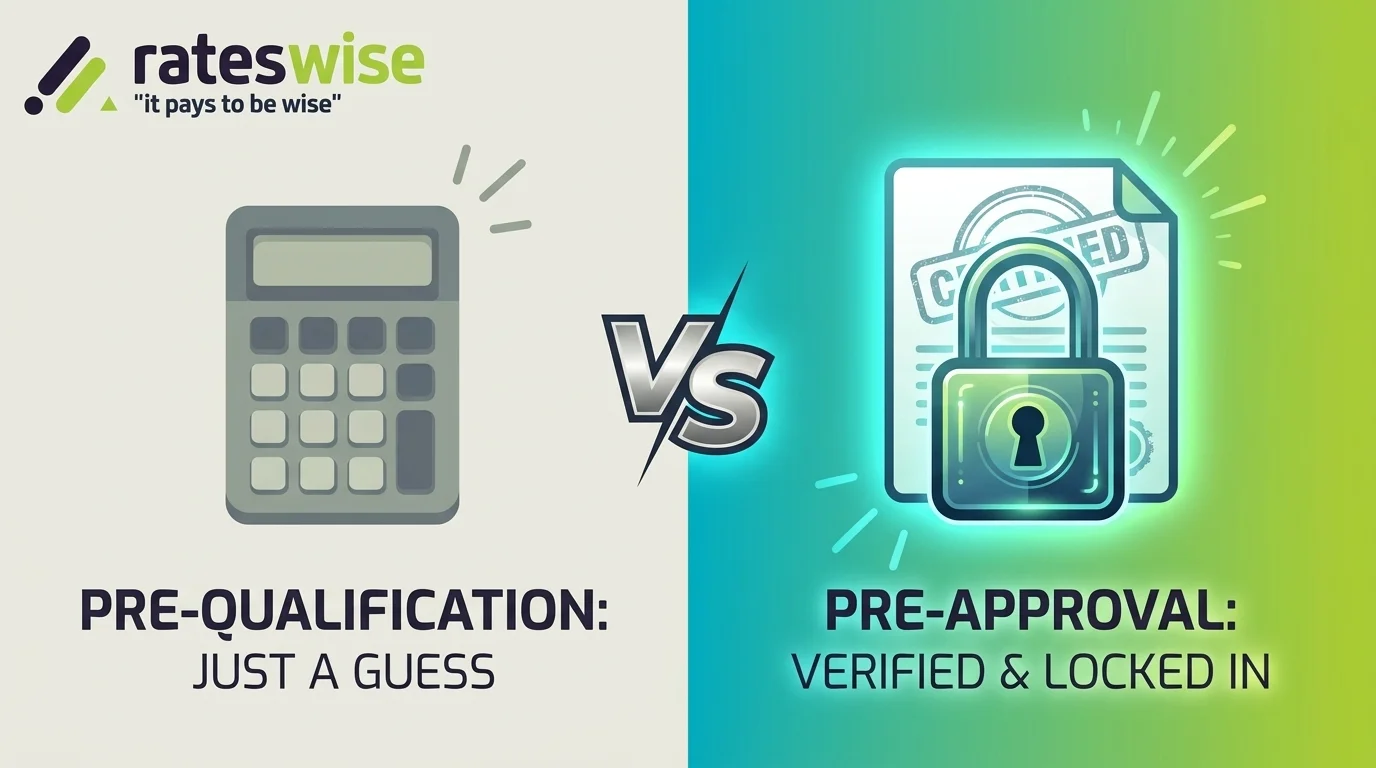
Pre-approval is different from pre-qualification. Pre-qualification is a rough estimate based on self-reported information. Pre-approval involves verified documentation, a credit check, and a rate hold. Always get pre-approved before making offers, never rely on pre-qualification alone.
Why pre-approval matters:
- purchases canly what you can afford before you start house hunting
- Your rate is locked for 90 to 120 days protection if rates rise
- Sellers and real estate agents take you seriously as a qualified buyer
- You can move quickly when you find the right home
- In a competitive market, a pre-approval letter strengthens your offer
Documents Required for Mortgage Pre-Approval in Canada 2026

Gathering documents before applying is the single fastest way to speed up your pre-approval. Missing documents are the number one cause of pre-approval delays.
Income verification:
- Last 2 pay stubs
- T4 or T4A slips (most recent 2 years)
- Most recent Notice of Assessment (NOA) from CRA
- Employment letter confirming position, employment type, and salary
Self-employed borrowers: 2 years of full tax returns, business financial statements, and NOAs. Lenders use your declared income on tax returns if you aggressively minimize taxable income, your qualifying mortgage amount will be lower. Some lenders offer stated-income programs for self-employed applicants with 20%+ down.
Identity verification:
- Government-issued photo ID (passport or driver's license)
- Current and matching the name on your mortgage application
Down payment verification:
- 90-day bank statements showing source of down payment
- Gift letter if funds are gifted (confirming no repayment required)
- Investment account statements if using RRSP or FHSA funds
Existing debts:
- Credit card statements
- Car loan or lease agreements
- Student loan statements
- Any other monthly debt obligations
How the Mortgage Stress Test Affects Pre-Approval in 2026
All federally regulated lenders apply the mortgage stress test at pre-approval. You must qualify at the higher of your contract rate plus 2%, or 5.25%.
June 2026 example: If your best available rate is 3.99% fixed, your stress test rate is 5.99%. You must prove you can afford payments at 5.99% not 3.99%.
The stress test typically reduces your borrowing power by 15 to 20% compared to qualifying at your actual rate. On a household income of $120,000, the difference can mean qualifying for a $50,000 to $80,000 less mortgage than the actual rate would allow.
Key debt service ratios:
- GDS (Gross Debt Service): Your housing costs (mortgage P&I + property tax + heat + 50% condo fees) must not exceed 39% of gross income
- TDS (Total Debt Service): All debt obligations (housing + car + credit cards + other loans) must not exceed 44% to 45% of gross income
Pre-Approval vs Pre-Qualification vs Mortgage Approval
Many Canadians confuse these three terms. The differences are significant.
Pre-qualification: A rough estimate based on self-reported information. No credit check. No rate lock. Not worth much in a competitive market.
Pre-approval: Verified income, credit check, documented assets. Rate locked for 90 to 120 days. Conditional on property appraisal and no changes to your finances. This is what you need before house hunting.
Mortgage approval (final): Full property appraisal, final employment verification, and confirmation that all conditions are met. Issued after your offer is accepted. This is the unconditional commitment.
Never assume pre-approval equals final approval. A pre-approval can be withdrawn if: you change jobs, take on new debt, make large purchases on credit, or if the property does not appraise at the purchase price.
What NOT to Do After Getting Pre-Approved
Do not change jobs. Lenders re-verify employment before closing. A job change even to a higher-paying role can delay or complicate final approval.
Do not make large purchases on credit. A new car loan or furniture financing changes your TDS ratio and could reduce your qualifying amount or disqualify you.
Do not open new credit accounts. New hard inquiries and new debt can lower your score and change your qualification picture.
Do not move large sums between accounts unexplained. Large transfers trigger anti-money-laundering review questions. Keep your finances stable and document any movements.
Do not co-sign for someone else. Their debt becomes your debt for qualification calculations.
How Long Does Pre-Approval Take in Canada?
With all documents ready and submitted through Rateswise, pre-approvals can be completed in as little as 24 to 48 hours.
Without documents organized in advance, the process takes 3 to 7 business days as lenders wait for verification.
Pre-approval is valid for 90 to 120 days. If you do not find a property within that period, you will need to reapply until your rate hold expires and your financial situation is re-verified.
The Rate Hold Advantage in 2026
In a stable or rising rate environment, the rate held from pre-approval is a meaningful financial benefit. Most lenders hold your rate for 90 to 120 days.
On a $500,000 mortgage, a 0.25% rate increase adds approximately $7,200 in interest over a 5-year term. A rate hold protects you against that cost while you shop.
If rates fall after your pre-approval, most lenders will honor the lower rate at closing. This asymmetric benefit protection against increases and access to decreases makes pre-approval valuable even when rates are stable.
Why Pre-Approve Through Rateswise vs a Single Bank?
When you apply directly to your bank, you receive one rate offering your bank's best for you. When you apply through Rateswise, we submit your profile to 60+ lenders simultaneously and present you with the most competitive offers available.
A single Rateswise application generates one credit inquiry, not 10 or 15 separate inquiries from shopping bank to bank. Credit bureaus treat multiple mortgage inquiries within a short period as a single inquiry, but the paperwork of applying separately to multiple lenders is time-consuming and unnecessary.
Get pre-approved through Rateswise 60+ lenders, one application →
Frequently Asked Questions: Mortgage Pre-Approval Canada 2026
Does mortgage pre-approval hurt my credit score?
A full pre-approval requires a hard credit inquiry, which can temporarily lower your score by 5 to 10 points. This effect is minor and typically recovers within a few months. Multiple mortgage inquiries within a short window are treated as a single inquiry by credit bureaus.
How long is a mortgage pre-approval valid in Canada?
Most pre-approvals are valid for 90 to 120 days. If you do not find a property within that period, you will need to reapply.
What is the difference between pre-qualification and pre-approval?
Pre-qualification is a rough estimate based on self-reported information with no credit check. Pre-approval involves verified documents, a credit check, and a rate hold is what you need before making offers.
Can I get pre-approved if I am self-employed?
Yes, but requirements are stricter. Lenders typically want 2 years of full tax returns, NOAs, and business financial statements. Some lenders offer stated-income programs for self-employed borrowers with 20%+ down.
What happens if my finances change after pre-approval?
Material changes, new debt, job change, large purchases can reduce your qualifying amount or trigger a re-evaluation. Keep your finances stable after pre-approval until your mortgage closes.