Why Oil Prices Are Pushing Up Canadian Mortgage Rates in 2026


Emily Carter
Senior Mortgage Content Specialist at Rateswise
September 24, 2026
- • The blockade of the Strait of Hormuz has kept crude oil above US$100 per barrel for weeks in 2026, with drone strikes on Saudi energy infrastructure briefly pushing Brent past $108. That energy shock is now feeding into Canadian mortgage rates.
- • Fixed mortgage rates in Canada are set by the Government of Canada 5-year bond yield, not the Bank of Canada's overnight rate. That yield has climbed from roughly 2.72% in late February to about 3.60% by mid-September 2026, pushing fixed rates higher even though the Bank hasn't touched its policy rate.
- • Canadian inflation held at 3.0% year-over-year in August 2026, kept there by gasoline, up 22.8%. Excluding gasoline, inflation rose to 2.4%. The Bank expects inflation to average around 2.5% in the second half of 2026 and hit target by early 2027.
- • The Bank of Canada held its overnight rate at 2.25% at its September 2 announcement, the sixth consecutive hold. Most Big Six banks expect a hold through year-end, though conditions are shifting fast enough that bond markets are watching closely for either direction.
- • Fixed rates have risen materially since the Strait of Hormuz situation escalated, and lenders repriced twice within five days in August alone. Barring a clear drop in oil or clear signs of economic softening, rates look more likely to hold or edge higher through the rest of 2026 than to fall.Fixed rates have risen materially since the Strait of Hormuz situation escalated, and lenders repriced twice within five days in August alone. Barring a clear drop in oil or clear signs of economic softening, rates look more likely to hold or edge higher through the rest of 2026 than to fall.
- • For homeowners renewing or buying in the next 90 days, waiting for fixed rates to come down isn't likely to pay off. Locking in while the renewal window is open is the lower-risk move.
- • In energy-producing provinces like Alberta, oil prices cut two ways: they raise borrowing costs through bond yields, but also support employment and housing demand in Calgary and Edmonton.
WHAT'S ACTUALLY HAPPENING WITH OIL AND CANADIAN MORTGAGE RATES
Most Canadian homeowners know the Bank of Canada sets interest rates. What's less understood is that the overnight rate directly controls variable mortgage rates but has almost no pull on fixed rates. Fixed rates are set by the bond market, specifically the yield on the 5-year Government of Canada bond, and in 2026 that yield has moved the wrong way for borrowers.
The trigger is the Strait of Hormuz. The blockade there, combined with a partial closure of Red Sea shipping routes, has constrained global oil supply and pushed crude toward 2022-era highs, with Brent crossing US$100 for extended stretches and briefly touching $108 after drone strikes hit Saudi energy infrastructure in September. That pressure has flowed straight into Canadian inflation, which held at 3.0% year-over-year in August 2026, driven largely by gasoline, up 22.8% from a year earlier.
Elevated inflation means bond investors demand higher yields to protect the purchasing power of the money they're lending. The 5-year GoC bond yield sat near 2.72% in late February, climbed through the summer as oil and US Treasury yields rose together, touched a 12-month high near 3.36% on August 21, and has continued upward since, trading around 3.60% by mid-to-late September. Fixed mortgage rates, priced above that yield by a spread reflecting lender risk and competition, have moved up right alongside it. Lenders raised fixed rates twice within five days in August and haven't walked that pricing back.
HOW THE STRAIT OF HORMUZ CONNECTS TO YOUR MORTGAGE RATE

The link between a waterway in the Middle East and a mortgage in Toronto or Calgary runs through a clear chain.
The Strait of Hormuz is the narrow passage through which roughly a fifth of the world's traded oil moves from the Persian Gulf to global markets. A blockade there reduces global supply immediately, and when supply falls while demand holds steady, prices rise.
Higher oil prices raise Canadian consumer prices directly through gasoline and heating costs, and indirectly through the transportation cost in almost everything that moves by truck, ship, or plane. That pressure lifts the Consumer Price Index, the number the Bank watches against its 2% target.
Here's where it reaches your mortgage. The Bank's sole mandate is controlling inflation. When inflation runs above target, the Bank comes under pressure to raise its overnight rate. Bond markets don't wait for the Bank to act before pricing that risk in. When inflation comes in hot and oil suggests it'll stay that way, bond investors sell bonds, yields rise, and fixed mortgage rates move with them, exactly the pattern since spring 2026, as the Middle East conflict disrupted a key source of global oil supply and lifted energy prices and bond yields together.
WHERE THE BANK OF CANADA STANDS IN SEPTEMBER 2026
The Bank held its overnight rate at 2.25% at its September 2 announcement, a sixth straight hold. Governor Tiff Macklem was candid about the bind the Bank is in: monetary policy can't offset tariffs or influence global energy prices directly. What it can do is keep domestic inflation expectations from becoming unanchored.
Canada's economic picture in late 2026 is genuinely mixed. Real GDP grew at an annualized 3.3% in the second quarter, the fastest pace since 2023, led by oil and gas, a figure that's partly a function of the same high oil prices creating the inflation problem. Elevated crude prices are cushioning Canada's export revenue, propping up growth that would otherwise face more pressure from trade friction, including the roughly $27.6 billion in Canadian counter-tariffs that took effect September 8.
| Bank of Canada Key Figures (September 2026) | Value |
|---|---|
| Overnight target rate | 2.25% |
| Prime rate | 4.45% |
| Inflation (August 2026, YoY) | 3.0% |
| Gasoline price change (YoY) | +22.8% |
| Core CPI-trim | 1.9% |
| Core CPI-median | 2.0% |
| 5-year GoC bond yield (mid-to-late September) | ~3.60% |
The Bank can't cut in response to trade-related weakness while headline inflation sits at 3.0% and energy prices are the reason it's staying there. Its forecast still calls for inflation averaging around 2.5% in the second half of 2026, returning to 2% by early 2027, but that assumes oil doesn't push materially higher, an assumption that's looked shakier by the week as the Middle East conflict has dragged on.
WHY THIS HITS FIXED RATES HARDER THAN VARIABLE RATES
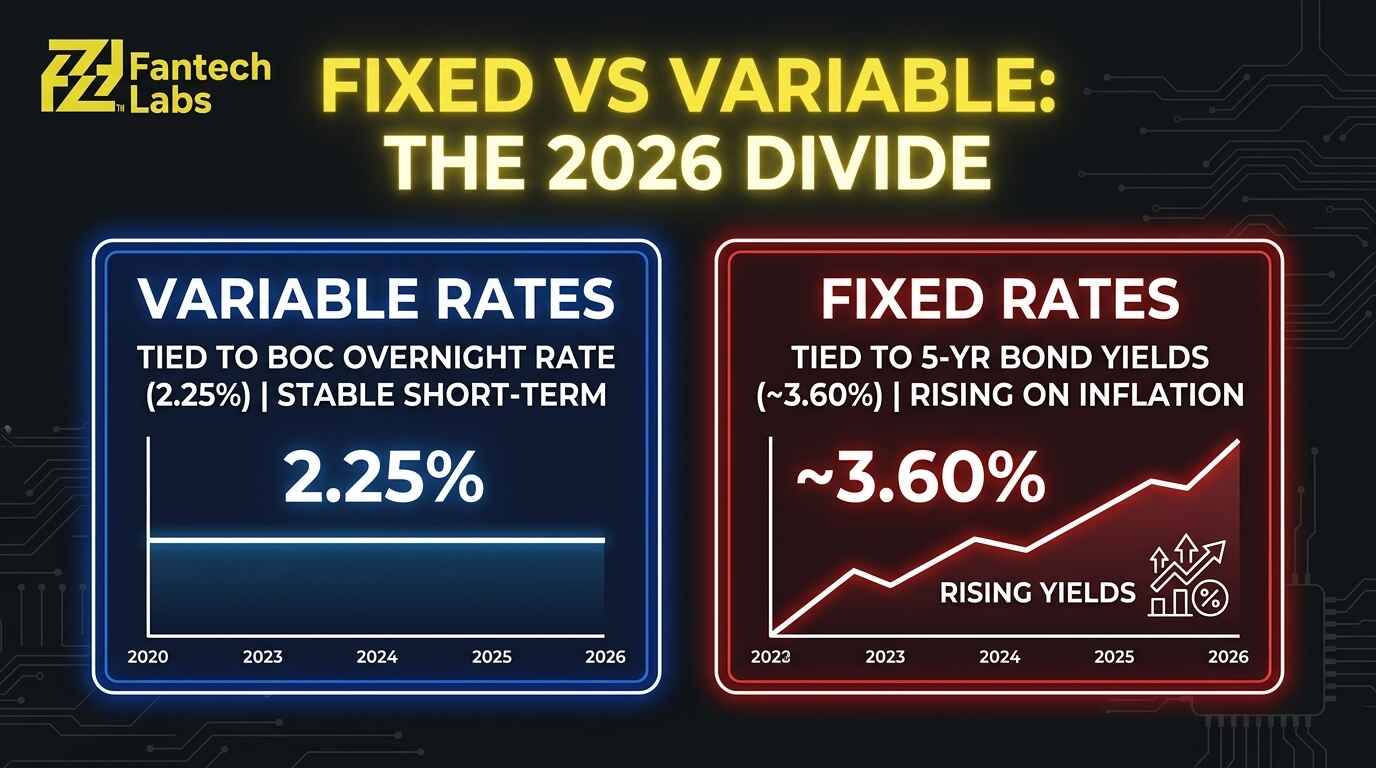
The oil-and-bond-yield story is primarily a fixed-rate story in 2026. Variable rates track the Bank's overnight rate through the prime rate. The Bank has held at 2.25% since October 2025, so variable rates are relatively stable near term, though market pricing of a possible move introduces real uncertainty over the next 3 to 12 months.
Fixed rates track the 5-year Government of Canada bond yield, set by bond market participants globally. It moves continuously with inflation data, growth signals, geopolitical events, and shifts in US Treasury yields, and the Strait of Hormuz situation has pushed it meaningfully higher without the Bank lifting a finger.
| Rate Type | What Drives It | Current Direction |
|---|---|---|
| Variable | Bank of Canada overnight rate | Stable to slightly higher |
| 5-year fixed | 5-year GoC bond yield | Elevated, risk of further increase |
| 3-year fixed | 3-year GoC bond yield | Elevated |
| 5-year GoC bond yield | Global bond markets, inflation | Volatile, upward pressure |
The practical result: fixed rates have already repriced higher in response to the oil shock, while variable rates remain anchored near the Bank's current policy rate. If bond yields ease as oil prices moderate, fixed rates could soften slightly, but there's no real signal yields are about to trend meaningfully lower without a clear resolution in the Strait of Hormuz or a definite sign of economic softening.
WHAT THIS MEANS FOR ALBERTA SPECIFICALLY
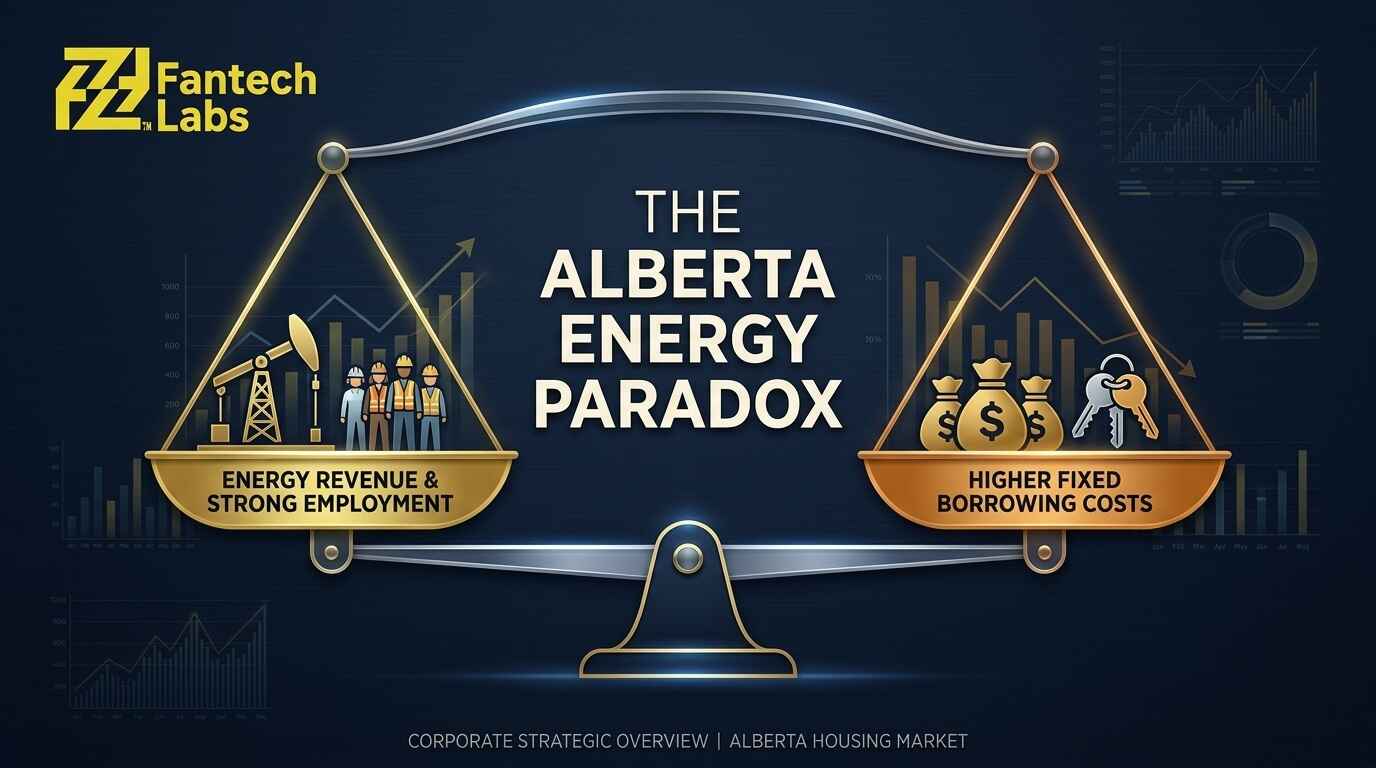
For homeowners and buyers in energy-producing provinces, especially Alberta, oil prices pull the mortgage market two ways at once.
On the cost side, elevated oil prices push gasoline higher, lift consumer prices, raise bond yields, and pressure fixed rates upward. A Calgary homeowner renewing in late 2026 faces higher fixed rates as a direct consequence of the same oil environment generating revenue for the province's dominant industry.
On the income side, high oil prices support Alberta's energy sector employment, confidence, and housing demand. Oil prices have historically tracked closely with employment and housing activity in Calgary and Edmonton, so a sustained stretch of crude above US$100 tends to support the conditions underpinning housing values and buyer capacity, even as it raises borrowing costs.
The net effect for Alberta is a market where demand and borrowing costs are both elevated at once, a different dynamic than provinces where energy prices are purely a cost with no offsetting employment benefit.
WHAT COULD BRING FIXED RATES DOWN
Fixed rates would fall meaningfully if the Strait of Hormuz resolved and oil dropped below roughly US$80 a barrel, easing the energy component of inflation. That would relieve bond market inflation expectations and give fixed rates room to follow.
They'd also fall if Canadian growth weakened sharply enough to raise real recession risk. In that scenario, the Bank would face pressure to cut, and bond yields would decline as investors moved into government debt.
Neither looks likely near term. The Strait of Hormuz situation hasn't shown clear signs of resolving. Canada's Q2 GDP growth was the strongest since 2023. The Bank has signaled it's watching for further inflation risk before considering cuts, and the ongoing CUSMA review, which formally began in July 2026, is adding its own risk premium to long-term yields given how contentious the negotiations are expected to be. The more likely path is that fixed rates hold near current levels or drift modestly higher through the rest of 2026.
WHAT CANADIAN HOMEOWNERS SHOULD DO RIGHT NOW
For anyone facing a renewal or purchase decision in the next 90 to 120 days, the guidance is fairly direct.
If you're renewing a fixed-rate mortgage, the risk of waiting for rates to drop is real. Bond yields reflect persistent inflation, new trade tariffs, and elevated oil prices at once. Barring a sudden contraction severe enough to outweigh those pressures, fixed rates are more likely to hold or rise than fall. Locking in through the 90-to-120-day rate hold most lenders offer protects against further increases while leaving room to benefit if conditions improve.
If you're weighing fixed against variable, the traditional case for variable, that the Bank's rate falls over your term and yours falls with it, is weaker than six months ago. The Bank has held at 2.25% since October 2025, and the oil environment is adding to inflation risk rather than easing it. A 5-year fixed offers budget certainty and protection if energy prices or tariffs push inflation higher. The choice now comes down more to your financial resilience against a payment increase than to any confident bet on where rates head next.
If you're a first-time buyer or working with a broker on a renewal, start rate shopping 90 to 120 days ahead of closing or renewal. That locks in a competitive rate now, protects you if yields keep climbing, and still leaves room for a better rate if conditions improve before you close.
THE LONGER VIEW: WHEN DOES THIS EASE?
The Bank of Canada's forecast still calls for inflation averaging around 2.5% in the second half of 2026, returning to 2% by early 2027, contingent on the Strait of Hormuz not deteriorating further and oil not pushing materially higher.
Real GDP growth is expected to settle onto a lower path of roughly 1.5% to 1.9% through 2027 once the temporary boost from oil normalizes. That slower growth, paired with cooling inflation, would ordinarily create room for cuts in 2027. If that holds, fixed rates could start drifting lower in the second half of 2027.
For homeowners locking in a 5-year fixed rate in late 2026, that suggests their next renewal in 2031 may land in an easier rate environment than today, assuming the current geopolitical pressures don't become permanent.
FREQUENTLY ASKED QUESTIONS
Why are Canadian mortgage rates going up when the Bank of Canada isn't raising rates? The Bank of Canada doesn't set fixed rates. They're set by the bond market, specifically the 5-year Government of Canada bond yield, which has climbed from roughly 2.72% to about 3.60% in 2026 as oil above US$100, driven by the Strait of Hormuz blockade, has pushed inflation to 3.0% and bond investors have demanded higher yields to compensate. The overnight rate controls variable mortgages directly but has almost no direct pull on fixed rates.
What is the Strait of Hormuz and why does it affect Canadian mortgage rates?
The narrow waterway through which roughly a fifth of the world's traded oil moves from the Persian Gulf to global markets. The 2026 blockade has constrained supply and pushed crude above US$100 a barrel, raising Canadian consumer prices through gasoline and transportation and pushing inflation above the Bank's 2% target. Bond investors respond with higher yields, which lift the 5-year GoC bond yield and, through it, fixed mortgage rates.
Should I take a fixed or variable mortgage rate in Canada right now?
The overnight rate has held at 2.25% since October 2025. Variable rates are stable near term but carry upside risk if oil-driven inflation forces the Bank's hand eventually. Fixed rates are elevated but offer certainty against further increases. The right call depends more on your financial resilience to a payment increase than on a confident read of where rates go next, which is genuinely uncertain right now.
What is the current Bank of Canada rate and 5-year bond yield?
The overnight rate is 2.25% as of the September 2, 2026 announcement, a sixth consecutive hold. Prime is 4.45%. The 5-year GoC bond yield has been trading around 3.60% in mid-to-late September. Inflation held at 3.0% year-over-year in August, with gasoline up 22.8%.
When will Canadian fixed mortgage rates come down?
When the 5-year GoC bond yield falls, which needs either oil dropping below roughly US$80 a barrel and inflation easing toward the Bank's 2% target, or a slowdown severe enough to send bond investors into government debt as a haven. Neither looks likely near term. The Bank's forecast expects inflation back to 2% by early 2027, and if that holds, fixed rates could drift modestly lower in the second half of 2027. Current conditions point to rates holding near today's levels or rising modestly through the rest of 2026.
SUMMARY
The mortgage story in Canada right now isn't really about the Bank of Canada. It's about a blockade in the Persian Gulf pushing oil past US$100, feeding straight into inflation, and dragging the 5-year GoC bond yield, and with it fixed mortgage rates, higher without the Bank moving its policy rate at all. For anyone renewing or buying in the next few months, the safer bet is to lock in during the window you have rather than wait for a drop that current conditions don't support.
DISCLAIMER
This article is for general educational purposes only and does not constitute financial, legal, or mortgage advice. Rate and economic data reflect publicly available information as of September 2026 and can shift quickly given how fast conditions are moving. Speak with a licensed mortgage professional before making any borrowing decision.

Related Articles