Mortgage Renewal Shock 2026: What Ontario Homeowners Renewing This Year Need to Know


Emily Carter
Mortgage Education Specialist
August 12, 2026
- • Approximately 60% of Canadian homeowners renewing in 2026 will face higher monthly payments than their previous term, according to Bank of Canada research.
- • Fixed-rate borrowers who locked in at 1.5% to 2.5% during 2020 and 2021 are now renewing into a 4.0% to 4.29% environment, resulting in a 15% to 24% increase in payments for most borrowers.
- • A homeowner with a $550,000 mortgage balance renewing in 2026 can expect to pay an extra $600 to $800 per month compared to their pandemic-era rate.
- • Ontario mortgage delinquency balances were up 52% year-over-year in Q1 2026 according to Equifax Canada, the highest rate of increase in Canada.
- • The Bank of Canada has held its overnight rate at 2.25% through six consecutive announcements as of July 2026, keeping the prime rate at 4.45%.
What Is Mortgage Renewal Shock and Why Is It Happening in 2026?
Mortgage renewal shock is the payment increase a homeowner experiences when a low-rate mortgage from a previous term expires and renews at the current market rate. In 2026, renewal shock is happening at scale in Ontario because a large wave of mortgages signed during the 2020 and 2021 pandemic period, when the Bank of Canada held its overnight rate at 0.25% and five-year fixed mortgage rates fell below 2%, are now coming due simultaneously.
Approximately 1.15 million Canadian mortgages are renewing in 2026, according to economic projections. Roughly 60% of those borrowers, or about 40% of all outstanding Canadian mortgages, are renewing into a rate environment that is materially higher than when they signed, according to Bank of Canada research. The overnight rate peaked at 5.00% in July 2023 before the Bank cut nine times to reach 2.25%, where it has held since October 2025. Even at 2.25% overnight, the five-year fixed mortgage rate sits at 4.0% to 4.29% in the broker channel as of July 2026 — roughly double where it was when most pandemic-era borrowers signed.
How Much More Will Ontario Homeowners Pay at Renewal in 2026?
The payment increase at renewal depends on the original rate, the remaining balance, and the amortization period remaining. Ontario homeowners face some of the largest dollar-value increases in Canada because of higher average property values and larger mortgage balances.
| Original Rate (2020-2021) | Best Broker Renewal Rate (Aug 2026) | Best Broker Renewal Rate (Aug 2026) Payment Increase % | Monthly Dollar Increase ($550K balance) |
|---|---|---|---|
| 1.39% (5-year fixed low) | 4.04% (5-year fixed insured) | 24% to 28% | $700 to $850 |
| 2.0% (5-year fixed) | 4.04% (5-year fixed insured) | 20% to 24% | $600 to $750 |
| 2.5% (5-year fixed) | 4.19% (5-year fixed uninsured) | 14% to 18% | $420 to $580 |
| 1.5% (variable, adjusted payments) | 3.40% (5-year variable insured) | 5% to 10% | $100 to $300 |
| 1.5% (variable, negative amortization) | 4.04% to 4.29% (reset required) | 30% to 40% | $700 to $950 |
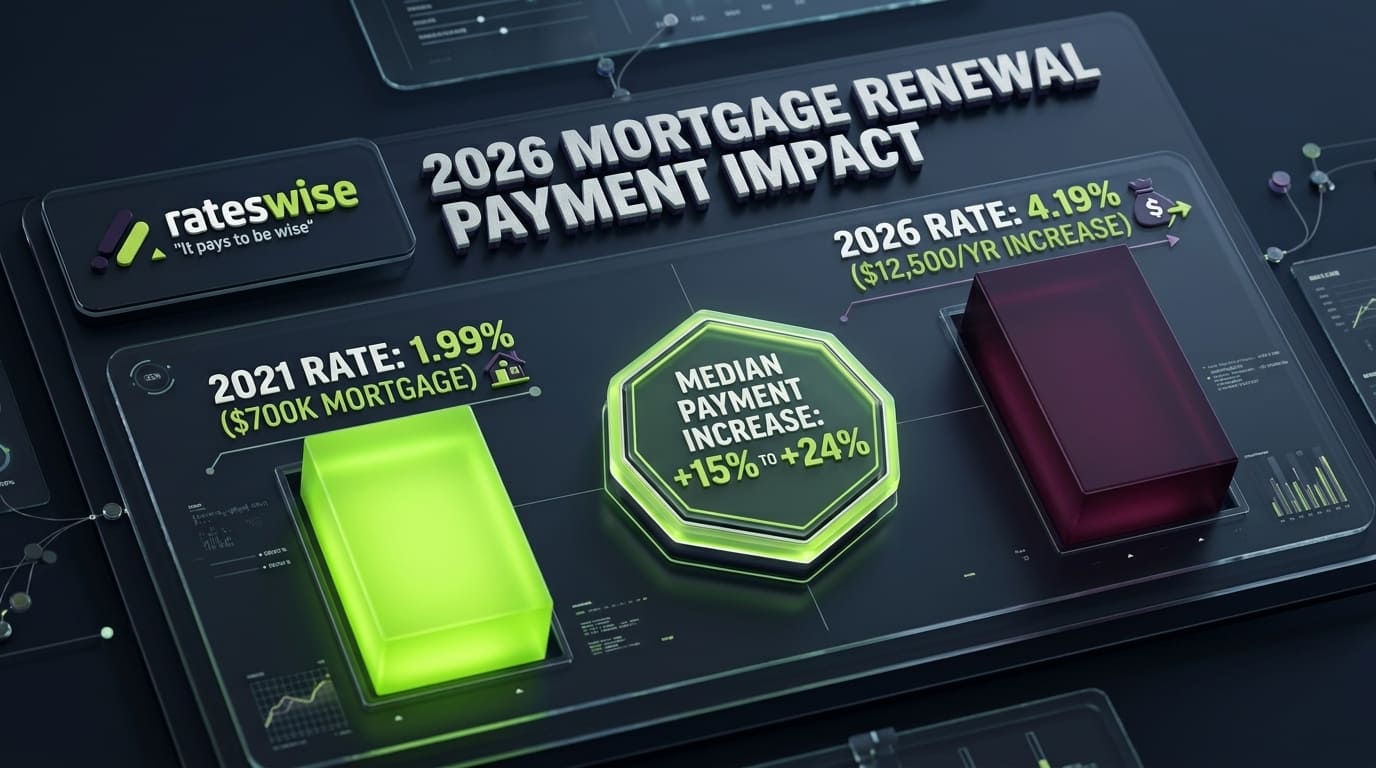
According to data from CMHC and Ratehub, a borrower renewing a standard five-year fixed-rate mortgage in 2026 faces a median payment increase of 15% to 24%. For approximately 10% of highly leveraged borrowers in Ontario, the shock can reach 40%.
Toronto and Ottawa homeowners face average monthly increases of $680 or more because of higher mortgage balances in those markets. For a homeowner who originally borrowed $700,000 at 1.99%, renewing at 4.19% on the same amortization adds approximately $12,500 per year in mortgage payments.
What Are Current Mortgage Rates in Ontario in 2026?
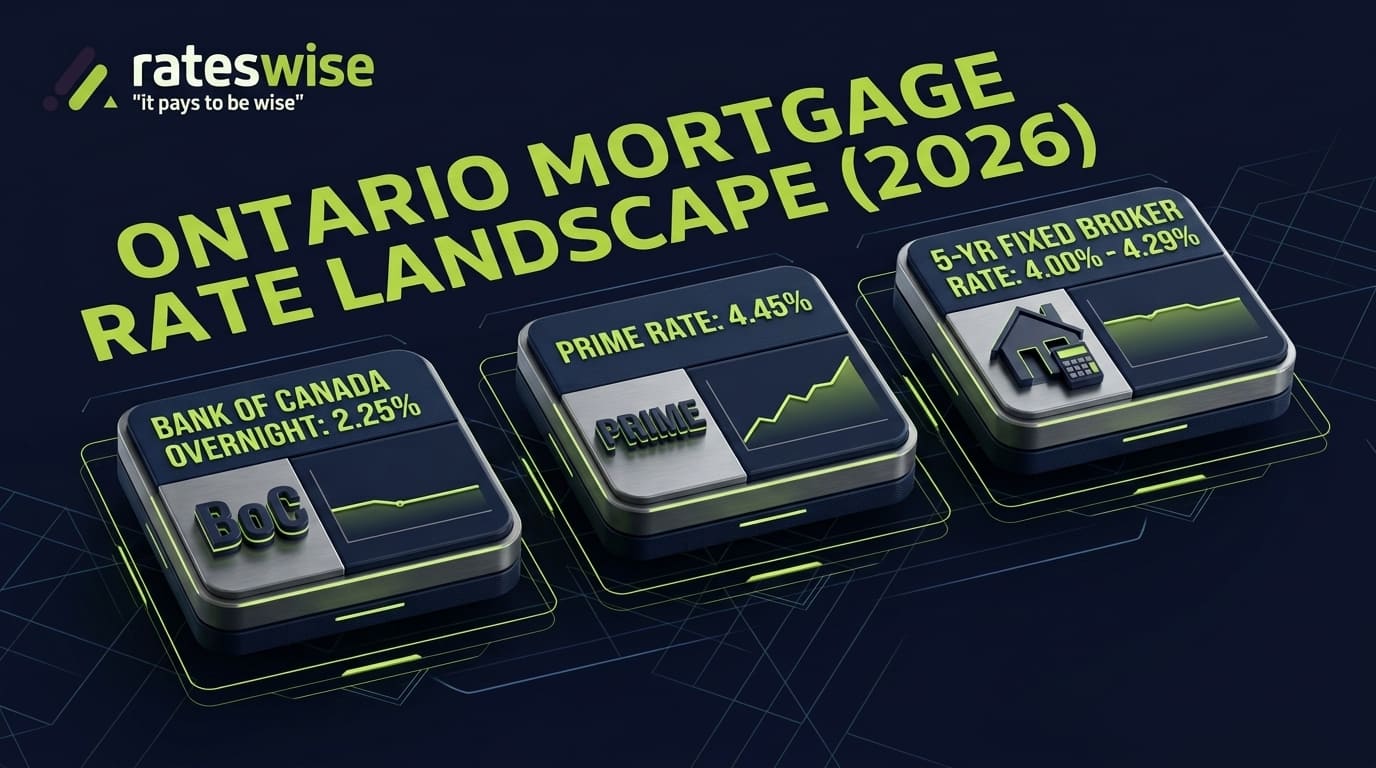
The Bank of Canada held its overnight rate at 2.25% at its July 15, 2026 announcement, the sixth consecutive hold. The prime rate sits at 4.45%. Five-year Government of Canada bond yields are trading around 3.15% as of late July 2026, anchoring fixed mortgage rates in the following ranges:
| Mortgage Type | Best Broker Rate (Aug 2026) | Big 6 Bank Posted Rate | Notes |
|---|---|---|---|
| 5-year fixed (insured / high ratio) | 4.04% | 4.24% to 4.86% | Ratehub / WOWA as of Aug 9 |
| 5-year fixed (uninsured) | 4.19% to 4.29% | 4.32% to 4.96% | Most renewal borrowers |
| 3-year fixed (insured) | 3.89% | 4.43% to 4.67% | Good middle-ground option |
| 2-year fixed (insured) | 3.94% | 4.31% to 4.76% | Short term, rates may improve |
| 5-year variable (insured) | 3.40% | 3.65% to 4.90% | Tracks prime at 4.45% |
| 5-year variable (uninsured) | 3.35% | 3.98% to 4.49% | Best for rate drop bets |
| HELOC | 4.95%+ | Varies by lender | Revolving credit, not renewal |
Bond yields have been pushed higher in July to August 2026 by uncertainty around U.S. trade relations and renewed geopolitical tension, causing some lenders to increase fixed mortgage rates from the lows seen in late 2025. Broker channel rates remain significantly lower than Big 6 bank posted rates, with the gap averaging 0.20% to 0.60% depending on the term. Borrowers who accept their lender's first renewal offer without shopping are often leaving thousands of dollars on the table.
What Is Different About Renewing in Ontario Compared to Other Provinces?
Ontario borrowers face the most acute renewal pressure in Canada for three reasons.
First, Ontario home prices remain among the highest in Canada, which means mortgage balances are larger and the dollar impact of any rate increase is amplified.
Second, Ontario's mortgage delinquency rate rose 52% year-over-year in Q1 2026 according to Equifax Canada, the steepest increase of any province, reflecting concentrated financial strain among the 2021 renewal cohort.
Third, the Toronto area has a disproportionate share of borrowers who took on maximum amortizations and high loan-to-value mortgages during the pandemic boom, leaving less equity buffer to absorb payment increases.
The Bank of Canada's Financial Stability Report identified that approximately 9% of borrowers in the Toronto area may not qualify to refinance at current 2026 rates and prices, compared to roughly 4% nationally. This does not mean those borrowers will lose their homes, but it does mean they may have limited options beyond renewing with their existing lender.
Who Is Most Affected by Mortgage Renewal Shock in 2026?
Not every Ontario homeowner renewing in 2026 faces equal pressure. The outcome depends heavily on which type of mortgage the borrower held and how they managed it during the 2022 to 2023 rate-hike cycle.
\
| Borrower Type | Situation at Renewal | Payment Outcome |
|---|---|---|
| 5-year fixed signed at 2.0% in 2021 | Renewing at 4.0%+ after stable payments | 20% to 25% increase |
| Variable rate with fixed payments (trigger rate hit) | Negative amortization during rate hikes, larger balance now | Up to 40% increase |
| Variable rate with adjustable payments | Payments already rose with rate hikes, now adjusting back down | May see decrease or small increase |
| 3-year fixed signed in 2022 or 2023 at 4%+ | Renewing into similar or lower rate | Minimal change or slight decrease |
| Borrowers who made prepayments during the term | Smaller remaining balance offsets rate increase | Smaller dollar increase |
Fixed-payment variable-rate mortgage holders who experienced negative amortization during the 2022 to 2023 rate hike cycle face the most complex renewal. Their outstanding balance may be larger than when they signed, and their lender must reset the amortization at renewal to a qualified period, which can create a payment cliff that catches borrowers off guard even when rates have since declined.
What Are the Best Strategies for Ontario Homeowners Renewing in 2026?
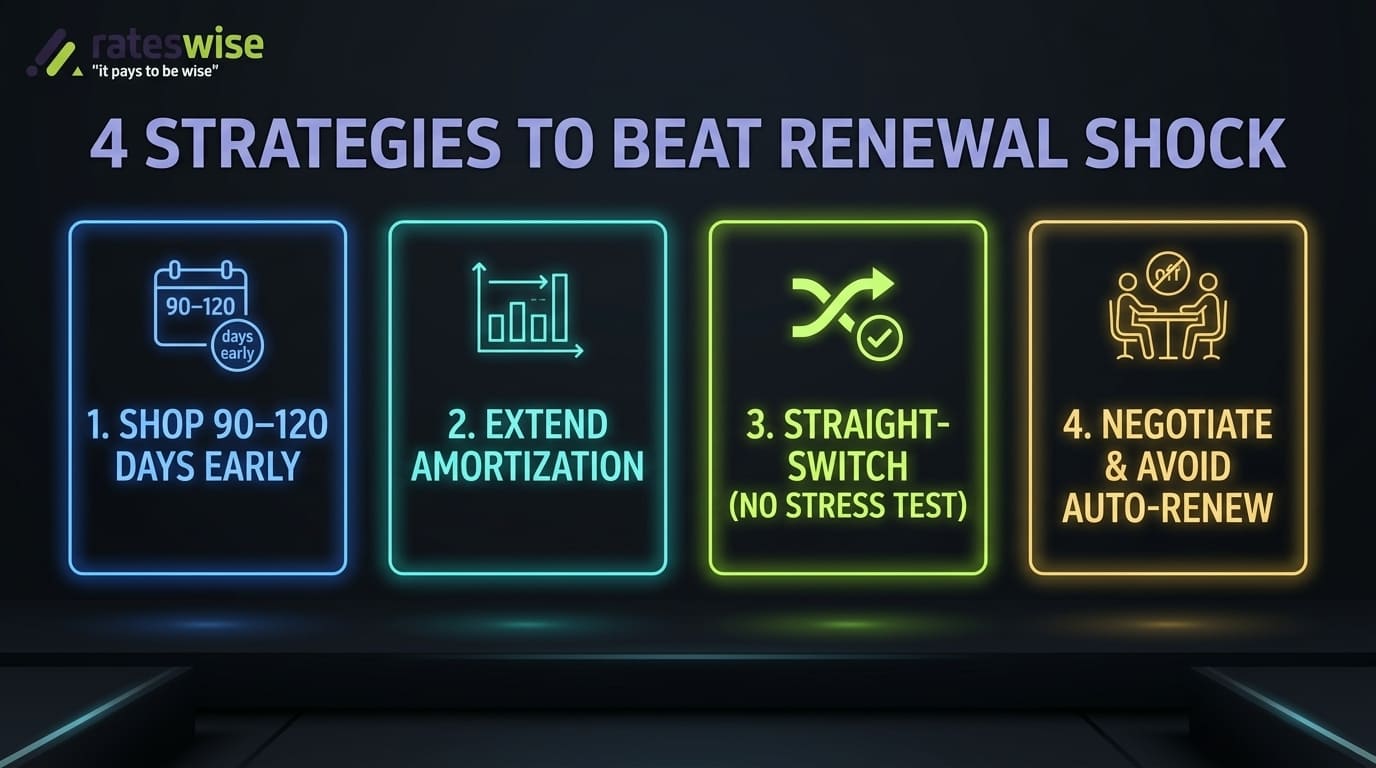
Shop Rates 90 to 120 Days Early
Most lenders allow borrowers to lock in a renewal rate 90 to 120 days before the maturity date without triggering prepayment penalties. This is the single most effective action available to renewing borrowers. Broker-channel rates are consistently lower than posted bank rates, and the difference on a $500,000 balance can amount to $2,000 to $4,000 per year.
Straight-switch renewals, where the borrower moves to a new lender without changing the mortgage amount, are now exempt from the stress test following the 2024 OSFI change. This means switching lenders at renewal is easier than it used to be, and borrowers are no longer penalized for shopping around.
Consider Extending the Amortization
For borrowers whose original amortization was 25 years and who have 20 years remaining, extending back to 25 or 30 years at renewal reduces the monthly payment even if the rate is higher. A $550,000 mortgage at 4.19% over 20 remaining years carries a monthly payment of approximately $3,380. The same balance at 4.19% over 25 years carries a payment of approximately $2,950, saving $430 per month.
The trade-off is paying more total interest over the life of the mortgage. Extending is the right choice for borrowers whose immediate cash flow is strained, not for borrowers who can absorb the payment and want to build equity faster.
Negotiate Rather Than Auto-Renew
Lenders send renewal letters with their posted rate, which is rarely their best rate. Calling the lender and asking for a better rate, or presenting a competing offer from a broker, typically results in a lower rate. Lenders prefer to retain existing customers rather than lose them to a competitor, and most will discount the posted rate by 0.10% to 0.40% for borrowers who ask.
Consider a Shorter Term
With the Bank of Canada holding at 2.25% and most major bank economists projecting stability through 2026, the rate environment in 2027 and 2028 is genuinely uncertain. A 2 or 3-year fixed term rather than a 5-year term gives borrowers the option to reassess sooner if rates move in either direction. The three-year fixed rate in July 2026 is slightly higher than the five-year fixed, but the premium is modest enough that the optionality may be worth it for borrowers who expect their financial situation to change.
Use a Mortgage Renewal Calculator
Running your own numbers before speaking with a lender or broker puts you in a stronger negotiating position. A mortgage renewal calculator shows the exact payment at different rate and amortization combinations, so you can see the trade-offs between a shorter term at a higher rate, an extended amortization, and a lump-sum prepayment before renewal.
What Happens If You Cannot Afford Your Renewal Payment?
Borrowers who genuinely cannot afford the payment at renewal have several options, and none of them require losing the home immediately.
The first step is contacting the lender before missing a payment. All major Canadian lenders have mortgage assistance programs that allow temporary payment deferrals, interest-only periods, or amortization extensions for borrowers in financial difficulty. These options are easier to access when the borrower initiates the conversation proactively rather than after missing payments.
The second option is refinancing to consolidate higher-interest debt, which can reduce total monthly obligations even if the mortgage rate itself is higher. A borrower carrying $40,000 in credit card debt at 19.99% alongside a mortgage may find that consolidating into a refinanced mortgage at 4.5% reduces total monthly cash outflow significantly.
The third option, available only to borrowers with sufficient equity, is downsizing or selling before the renewal date. Ontario home values have stabilized since their 2022 peak but remain historically high, meaning most borrowers who purchased before 2022 have meaningful equity to work with.
The Bank of Canada's Financial Stability Report notes that most renewing borrowers have paid down some principal over their term and may have seen home value appreciation, giving them refinancing options that were not available to the 2023 and early 2024 renewal cohorts who faced a more acute rate shock at the peak of the hiking cycle.
Frequently Asked Questions
What is the mortgage renewal shock in Canada?
Mortgage renewal shock in Canada refers to the payment increase homeowners experience when a mortgage term expires and renews at the current market rate, which is higher than the rate on the expiring term. In 2026, renewal shock is widespread because approximately 1.15 million mortgages signed during the 2020 and 2021 pandemic period at rates below 2% are coming due into a market where five-year fixed rates sit at 4.0% to 4.29%.
How much will my mortgage payment increase at renewal in Ontario in 2026?
For a five-year fixed-rate mortgage originally signed at 2.0% in 2021, renewing at the current five-year fixed rate of approximately 4.19% in 2026 increases monthly payments by roughly 20% to 25%. On a $550,000 mortgage balance, that translates to an extra $600 to $800 per month. Variable-rate borrowers who experienced negative amortization during the rate hike cycle may face increases up to 40%.
Do I have to pass the stress test when renewing my Ontario mortgage in 2026?
If you renew with your existing lender at the end of your term, you do not need to pass the stress test under the 2024 OSFI straight-switch exemption. If you switch to a new lender at renewal, you are required to re-qualify, which includes passing the stress test at the greater of your contract rate plus 2% or 5.25%. Shopping for the best renewal rate is still worthwhile because broker-channel rates are typically 0.20% to 0.50% lower than the first offer from your existing lender.
What is the Bank of Canada rate in 2026 and how does it affect my renewal?
The Bank of Canada overnight rate is 2.25% as of July 2026, held steady through six consecutive announcements. The prime rate is 4.45%. For variable-rate mortgage holders, this directly determines their rate. For fixed-rate renewal borrowers, the overnight rate influences bond market sentiment but the five-year fixed rate is primarily driven by five-year Government of Canada bond yields, which sit at approximately 3.15% in July 2026 and anchor fixed rates near 4.19% to 4.29% in the broker channel.
Should I take a fixed or variable rate when renewing my Ontario mortgage in 2026?
Most major bank economists project the Bank of Canada overnight rate will hold at 2.25% through 2026, with diverging views on 2027. In this environment, a five-year fixed rate provides certainty at a known cost. A variable rate offers slightly more flexibility and a modest discount to prime, but carries the risk of rate increases if the Bank resumes hiking. The right choice depends on your cash flow tolerance for payment variability and how long you plan to stay in the home. A shorter fixed term of 2 or 3 years is a reasonable middle ground for borrowers uncertain about the rate direction.
Summary: What Ontario Homeowners Need to Do Right Now
Mortgage renewal shock in 2026 is real, and it is hitting Ontario homeowners harder than any other province. The combination of large pandemic-era mortgage balances, higher average property values, and the 200-basis-point gap between 2021 rates and current five-year fixed rates is creating genuine financial pressure for hundreds of thousands of Ontario families.
The borrowers who come through renewal in the best position are those who act early. Shopping rates 90 to 120 days before maturity, comparing broker-channel offers against the lender's first offer, and running the amortization extension numbers before the renewal conversation all put the borrower in a position to make an informed decision rather than a reactive one.
The borrowers most at risk are those who auto-renew without shopping, who did not realize their variable-rate mortgage was in negative amortization during the rate hike cycle, or who are carrying significant unsecured debt alongside a renewing mortgage. For those borrowers, speaking with a licensed mortgage professional before the renewal date, not after, is the most important step they can take.
Disclaimer: This article is for general educational purposes only and does not constitute financial, legal, or mortgage advice. Rate data is based on publicly available information as of July 2026. Speak with a licensed mortgage professional before making any borrowing decision.