Reverse Mortgage vs HELOC for Ontario Retirees: Which Makes More Sense in 2026


Emily Carter
Mortgage & Personal Finance Writer
August 7, 2026
- • A reverse mortgage requires no monthly payments and suits retirees on fixed income who cannot qualify for a HELOC.
- • A HELOC carries a lower interest rate but requires monthly interest payments and income verification, which many retirees cannot meet.
- • Reverse mortgage interest rates are generally higher than HELOC rates, while HELOCs usually offer lower borrowing costs but require borrowers to qualify based on income, credit, and lender requirements.
- • Reverse mortgages allow homeowners aged 55 and older to access up to 55% of their home's value tax-free without selling.
- • The right choice depends on three things: your income, how long you plan to stay in the home, and how much equity you want to preserve for heirs.
- • Ontario retirees who cannot qualify for a HELOC due to limited pension income often find a reverse mortgage is the only practical way to access home equity without moving.
What Is the Difference Between a Reverse Mortgage and a HELOC for Retirees?
A reverse mortgage and a HELOC both let Ontario homeowners borrow against the equity in their home, but they work in fundamentally different ways. A reverse mortgage provides tax-free cash with no required monthly payments, and the loan balance grows over time until the home is sold or the last borrower passes away. A HELOC is a revolving line of credit secured against your home that requires monthly interest payments and income qualification, but carries a lower interest rate.
For retirees on fixed income, the distinction matters more than it might at first appear. A HELOC with a lower rate is only useful if you can qualify for it and afford the monthly payments. A reverse mortgage with a higher rate may be the only realistic option for a retiree whose income consists entirely of CPP, OAS, and a modest pension.
| Feature | Reverse Mortgage | HELOC |
|---|---|---|
| Monthly payments | No required monthly payments | Monthly interest payments required |
| Qualification | Primarily based on age and home equity | Based on income, credit, and home equity |
| Interest rates | Generally higher | Generally lower |
| Access to funds | Lump sum, scheduled advances, or combination | Revolving line of credit |
| Best suited for | Retirees prioritizing cash flow | Borrowers who qualify and can manage repayments |
How Does a Reverse Mortgage Work in Ontario?
A reverse mortgage in Ontario allows homeowners aged 55 and older to access a portion of their home's equity as tax-free cash, with no required monthly payments. The loan balance, including compounding interest, is repaid when the home is sold, the last registered owner moves out permanently, or the last borrower passes away.
The two main lenders operating in Ontario are HomeEquity Bank, which offers the CHIP Reverse Mortgage, and Equitable Bank. Both are federally regulated, and both offer a No Negative Equity Guarantee, meaning you or your estate will never owe more than the home's fair market value at the time of sale.
HomeEquity Bank is one of Canada's largest reverse mortgage providers and offers the CHIP Reverse Mortgage, one of the country's best-known reverse mortgage products.
Its flagship CHIP product allows borrowers to access up to 55% of their home's appraised value, received as a lump sum, as scheduled advances, or a combination of both.
Reverse mortgage interest rates vary by lender, product, borrower profile, and market conditions. Comparing offers from multiple lenders helps ensure you understand the total borrowing cost before making a decision.
Independent legal advice is required before signing a reverse mortgage in every province, including Ontario.
Reverse mortgages may include setup costs such as appraisal, legal, and administrative fees. These costs vary depending on the lender and your individual circumstances.
How Does a HELOC Work for Retirees?
A home equity line of credit (HELOC) allows Ontario homeowners to borrow against their home equity up to a pre-approved limit, typically up to 65% of the home's value, with a combined loan-to-value limit of 80% when an existing mortgage is included. You draw funds as needed and pay interest only on what you use.
HELOC rates are variable and track the lender's prime rate. With the Bank of Canada overnight rate at 2.75% in 2026, HELOC rates are generally lower than reverse mortgage rates, making them a more cost-effective tool for homeowners who can use them.
The catch for retirees is qualification. HELOC lenders require income verification and typically apply the posted 5-year fixed rate as a stress test to confirm the borrower can repay the full balance within 25 years under current federal rules. For a retiree whose monthly income is CPP plus OAS, passing that stress test is often impossible regardless of how much equity they hold.
Many retirees have substantial home equity but may find HELOC qualification more challenging once employment income is replaced by pension or retirement income. Qualification requirements vary between lenders.
Reverse Mortgage vs HELOC: Rates and Costs
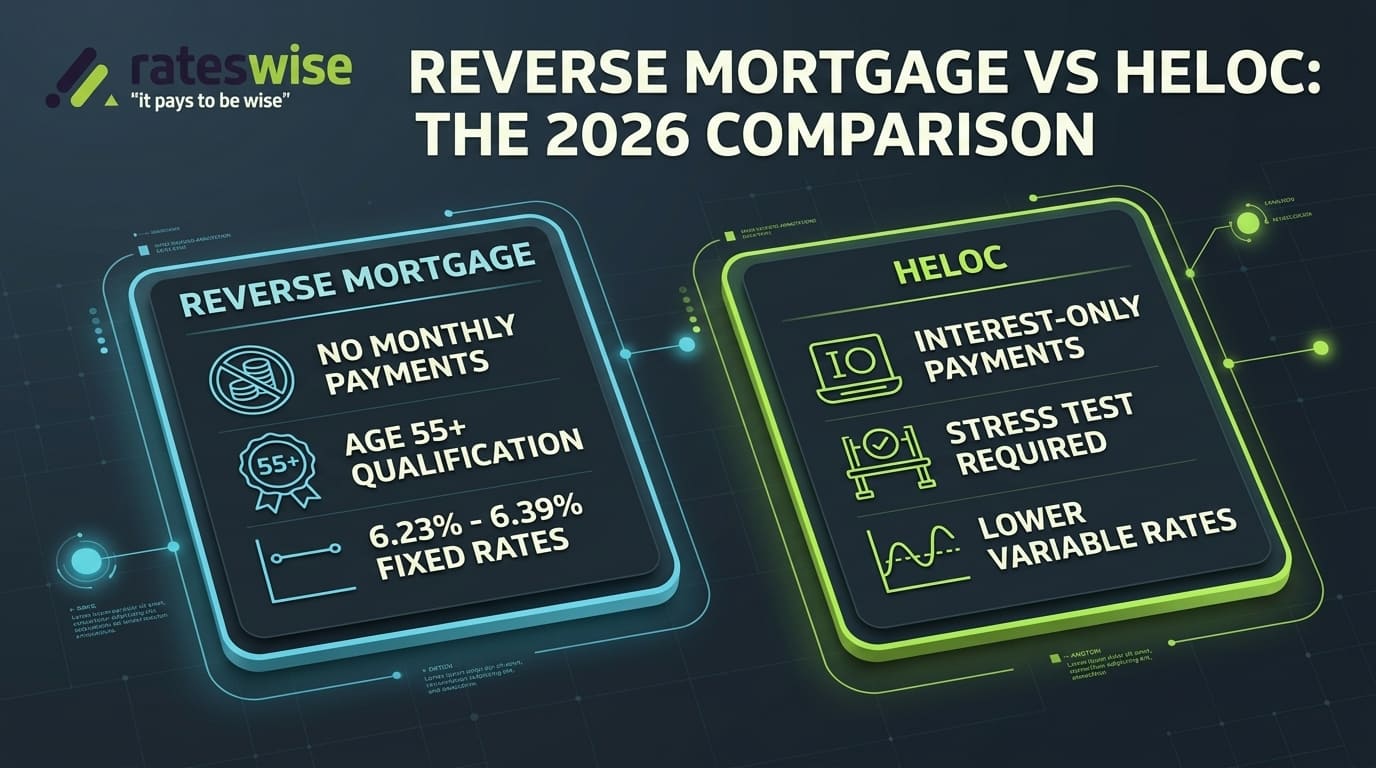
Although interest rates are often the first factor borrowers compare, they should not be the only consideration. Reverse mortgages generally carry higher interest rates than HELOCs because no monthly payments are required. However, borrowing costs also depend on factors such as repayment flexibility, lender fees, and how long the funds remain outstanding.
Interest rate is the most visible difference between the two products, but it is not the only cost to compare.
Reverse mortgage rates in Ontario as of July 2026 start at approximately 6.39% on a 5-year fixed term from HomeEquity Bank, with Equitable Bank and Home Trust at 6.23% and Bloom at 6.33%. Variable rate products from CHIP and Equitable Bank are available near 6.95% currently, though the rate gap between fixed and variable has narrowed considerably in 2026 following a competitive pricing move by Home Trust that the rest of the market matched.
HELOC rates are lower in nominal terms because they are variable and secured differently. However, reverse mortgage interest is charged only on the amount actually borrowed, not on the full approved limit. Over time, the compounding of interest on an unpaid reverse mortgage balance can erode home equity significantly, which is the most important long-term cost consideration for retirees who want to leave equity to their children or estate.
Setup costs for a reverse mortgage run approximately $1,795 all-in for most CHIP borrowers. A HELOC typically has lower or no setup costs at major banks, though legal and appraisal fees may apply.
Who Qualifies for Each Product in Ontario?
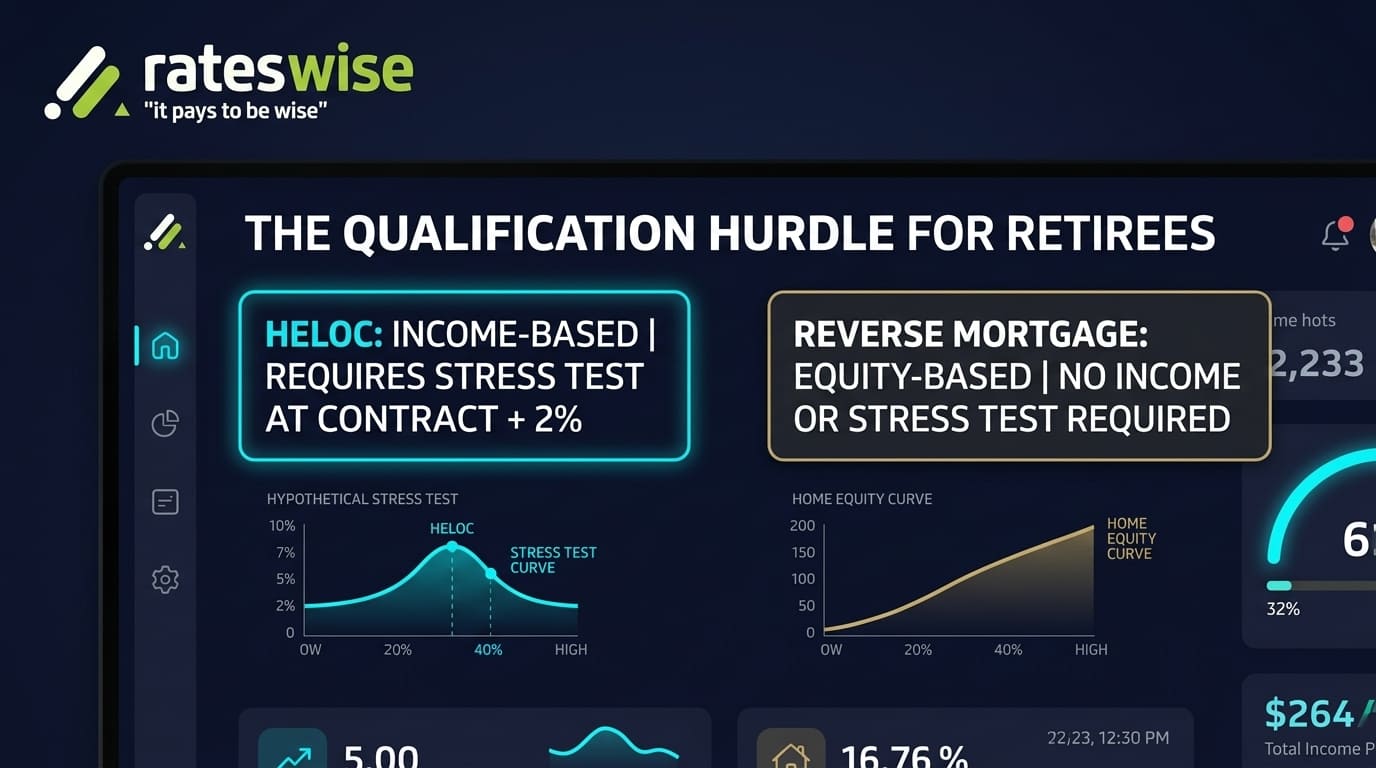
Qualifying for a reverse mortgage is primarily age- and equity-based. All registered owners on title must be 55 or older, the property must be your primary residence, and it must meet the lender's property type criteria. Income and credit score are not the deciding factors, which makes reverse mortgages accessible to retirees who have been out of the workforce for years.
Qualifying for a HELOC is income-based. Lenders apply the federal stress test using the posted 5-year rate, verify employment or pension income, and review credit history. A retiree living on CPP, OAS, and a defined benefit pension may have the home equity to theoretically support a large HELOC, but not the monthly income to pass the qualification test.
This asymmetry is the core practical issue for Ontario retirees. Being house-rich does not automatically translate into HELOC eligibility once employment income has stopped.
What Are the Tax Implications of Each Option?
Neither a reverse mortgage nor a HELOC generates taxable income on its own. The cash you receive from a reverse mortgage is not considered income by the Canada Revenue Agency, which means it does not affect your OAS clawback threshold, your GIS eligibility, or your marginal tax rate.
HELOC proceeds are similarly not taxable income. However, if you invest HELOC funds in income-producing assets, the interest paid on the HELOC may be deductible, which is not possible with a reverse mortgage where no interest is being paid in cash.
For most Ontario retirees using home equity to cover living expenses rather than investments, the tax treatment is effectively identical between the two products.
When Does a Reverse Mortgage Make More Sense Than a HELOC?
A reverse mortgage makes more sense when monthly cash flow is more important than minimizing interest costs. This is typically the case when the retiree cannot qualify for a HELOC due to limited pension income, when the goal is to eliminate all monthly debt obligations, or when the homeowner is 70 or older and does not expect to sell for 10 or more years.
RatesWise data shows that Ontario retirees using a reverse mortgage tend to draw relatively conservatively against their approved limit in the first several years, which limits the compounding effect on the balance. A retiree who borrows $150,000 against a $700,000 home at 6.39% and stays for 10 years will see the balance grow to roughly $277,000 over a decade, assuming no further draws. With a home value that has grown modestly, this still leaves significant equity.
The reverse mortgage also provides certainty. The lender cannot demand repayment while you live in the home, cannot reduce the credit limit if property values fall, and cannot force a sale. That protection has real value for a retiree on a fixed income whose alternative would be selling and downsizing.
When Does a HELOC Make More Sense Than a Reverse Mortgage?
A HELOC makes more sense when the retiree has sufficient pension or investment income to pass the qualification test and can comfortably cover monthly interest payments. The lower rate preserves more equity over time, and the revolving structure means you only borrow what you actually need.
A HELOC also suits retirees who expect to repay the balance within a few years, perhaps from the sale of an investment property or an inheritance. The open repayment structure of a HELOC allows this without prepayment penalties, whereas a reverse mortgage carries prepayment charges if closed before the term ends.
For retirees under 70 with a defined benefit pension income alongside CPP and OAS, the HELOC is worth pursuing first, simply because the cost savings over a decade can be substantial on a large draw.
Frequently Asked Questions
Can an Ontario retiree qualify for a HELOC if their only income is CPP (Canada Pension Plan) and OAS (Old Age Security)?
Qualifying may be more challenging, but it isn't impossible. Most lenders count retirement income, including CPP (Canada Pension Plan), OAS (Old Age Security), and, where applicable, GIS (Guaranteed Income Supplement), when assessing a HELOC application. However, approval depends on your total income, existing debts, credit history, home equity, and the lender's qualification requirements. If your retirement income is limited, a reverse mortgage may be another option worth exploring.
Does a reverse mortgage affect OAS or GIS payments?
No. Funds received from a reverse mortgage are not considered income by the Canada Revenue Agency and do not affect OAS, GIS, or other income-tested benefits. This is one of the practical advantages of a reverse mortgage over selling assets, which may generate taxable capital gains.
What happens to a reverse mortgage when the homeowner passes away?
The reverse mortgage becomes due when the last registered borrower passes away. The estate typically has up to 6 months to repay the balance, usually by selling the home. Under the No Negative Equity Guarantee offered by HomeEquity Bank and Equitable Bank, the estate will never owe more than the home's fair market value at the time of repayment.
Can an Ontario homeowner have both a HELOC and a reverse mortgage?
Generally no. A reverse mortgage must typically be in first position on title, which means any existing mortgage or HELOC must be paid out at closing using the reverse mortgage proceeds. Some homeowners use a reverse mortgage to pay off an existing HELOC and then have access to new funds with no monthly payment obligation.
How much can an Ontario homeowner borrow with a reverse mortgage in 2026?
The maximum is 55% of the home's appraised value through standard CHIP products, with some broker-sourced arrangements reaching up to 59%. The actual amount approved depends on the age of the youngest borrower on title, the property type and location, and the lender's current guidelines. Older borrowers typically qualify for a higher percentage.
Summary: Which Option Is Right for You?
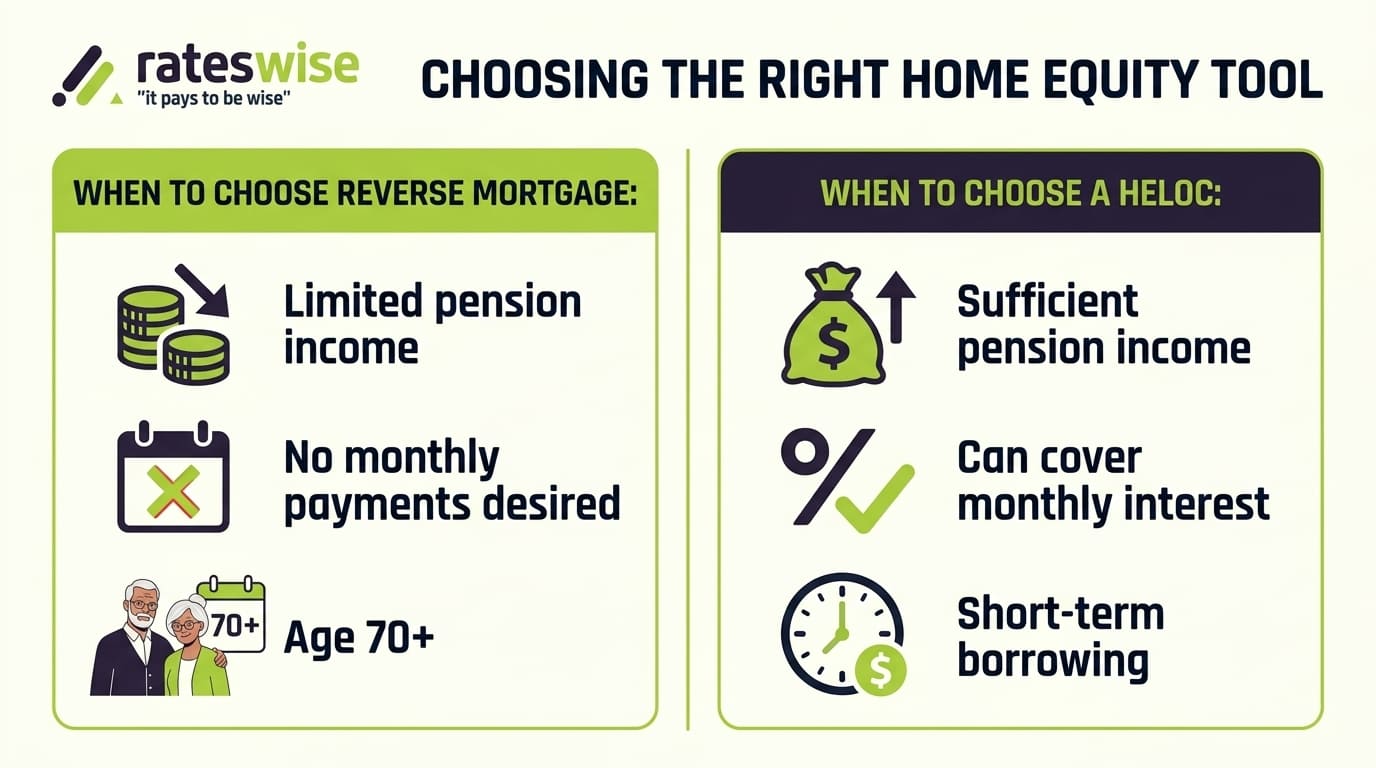
The right choice between a reverse mortgage and a HELOC for Ontario retirees comes down to three questions in order: Can you qualify for a HELOC given your current retirement income? Can you comfortably afford monthly interest payments without affecting your cash flow? And how important is preserving home equity for your heirs compared to maintaining your current lifestyle in your home?
If you cannot qualify for a HELOC, a reverse mortgage is not a compromise; it is the appropriate tool for the situation. If you can qualify and can absorb the monthly payments, a HELOC costs less over time and preserves more equity. If you are between those two positions, speaking with an independent mortgage broker who can model both options against your actual income, home value, and time horizon is the right next step.
Neither product is inherently good or bad. Both access the same underlying asset. The question is which one fits the specific income, age, and planning situation of the borrower in front of it.
Disclaimer: This article is for general educational purposes only and does not constitute financial, legal, or mortgage advice. Rates and lender details are based on publicly available information as of July 2026. Speak with a licensed mortgage professional and financial advisor before making any borrowing decision.